Last week the Supreme Court listened to arguments on the constitutionality the Protecting Americans from Foreign Adversary Controlled Applications Act, which would require TikTok to shut down unless its Chinese parent company, ByteDance, sells it by January 19, 2025, citing national security concerns. TikTok and its users argue that the law infringes on their First Amendment rights, while the government defends the law as necessary to prevent content manipulation by China and safeguard U.S. data from foreign adversaries. The Justices expressed skepticism about the First Amendment concerns, with some agreeing with the government’s national security arguments, while others questioned whether less restrictive alternatives could address the threat. The Court is set to act quickly, given the law’s impending deadline, with discussions focusing on whether the shutdown is an appropriate response to the security risks.
Overview: What were the three main issues covered?
1. Free Speech and the First Amendment: The central issue was whether the law unconstitutionally restricts speech, especially political speech, on platforms like TikTok. While free speech is the primary concern, national security concerns often provided the backdrop for this issue, particularly when speech is seen as potentially influencing public opinion in ways that could undermine national security interests. National security arguments are often used to justify government actions that limit certain types of speech or expression. In this case, the government may argue that foreign-controlled platforms (like TikTok, with ties to China) pose risks related to espionage, propaganda, or influence operations. However, the challenge is whether those concerns justify overriding First Amendment protections.
2. Misinformation, Disinformation, and National Security: The government defends the law by asserting the need to combat misinformation and disinformation, especially from foreign sources, that can affect democratic processes, elections, and national security. The focus is not just on harmful content but on content that could be linked to foreign actors potentially using these platforms to spread propaganda or destabilize the country. National security concerns are often tied to the idea that misinformation, especially when coming from foreign adversaries, can influence public opinion or even shape political outcomes in harmful ways. In this case, addressing disinformation becomes a matter of ensuring the security of the nation, alongside protecting citizens’ access to truthful information. However, the question arises whether the law’s approach to regulating speech could be seen as a disproportionate response to these national security threats.
3. Legislative Intent, National Security, and the Scope of the Law: The law’s legislative history is closely connected to concerns about national security, particularly the influence of foreign governments via social media platforms. The government argues that regulating platforms like TikTok is necessary to protect national security interests by limiting foreign influence, which might be masked as free speech or democratic expression. National security concerns can justify certain legal restrictions, especially when the government believes that foreign powers are using social media as a tool for manipulation or control. However, this raises the issue of how broadly the law can be applied without infringing on constitutional rights. The law might be intended to protect national security, but it also has the potential to curtail free speech and open discourse in ways that may be overly broad, especially if national security arguments are used as a blanket justification.
The Players
Government’s Argument
- National Security Concerns: Solicitor General Prelogar emphasized that the primary issue with TikTok is not just data privacy, but a national security risk. The Chinese government could access vast amounts of sensitive data about American citizens, including teenagers who may grow up to hold positions in government or military. This poses a threat of espionage and blackmail, making it a critical national security issue.
- Congressional Authority and Legitimacy: Prelogar argued that Congress, in conjunction with the executive branch, took steps to close a national security loophole by enacting laws aimed at addressing potential risks. This action is legitimate and based on a substantial record, including concerns about the data harm TikTok could pose. The Court has no formal basis to intervene or displace the deadline set by Congress.
- TikTok’s Ties to the Chinese Government: Prelogar highlighted that ByteDance, TikTok’s parent company, has manipulated the platform at the request of the Chinese government in the past, including tracking dissidents and censoring content. Congress considered this evidence in its legislative process, reinforcing the need for action to safeguard U.S. national security.
Roberts
- Concerns Over National Security and Control: Throughout his questions, Roberts focused on the issue of ByteDance, the parent company of TikTok, being subject to Chinese laws that require cooperation with Chinese government intelligence. This concern seems to support the Respondents’ position that national security interests are at stake. Roberts repeatedly questioned whether it is appropriate to ignore this relationship and the potential for Chinese control over the platform’s data, indicating that he is not dismissing the national security justification for the proposed ban.
- Corporate Structure vs. Free Speech: Roberts challenged the Petitioners’ argument that regulating TikTok’s corporate structure is a direct restriction on free speech. He pressed on whether there is any precedent for treating corporate regulation as a direct imposition on speech, suggesting that this concern may not align with past precedents. His questions seemed to suggest that the regulation of TikTok’s ownership structure, rather than content manipulation, might not warrant the same constitutional scrutiny regarding free speech. This aligns with the Government’s view that the issue is not about regulating expression, but about national security and foreign interference.
- Focus on Data Harvesting: In his questioning, Roberts also highlighted the concern over data harvesting by a foreign entity and its potential future use. He pointed out that Congress is not concerned with the content on TikTok but with the Chinese government’s ability to gather information about millions of Americans. This reflects the Respondents’ argument that the issue is about control and data, not censorship, which Roberts seems to support in his line of questioning.
Alito
- Foreign Government Control and First Amendment: Alito challenged the Petitioners by questioning whether a hypothetical situation, where TikTok is fully controlled by the Chinese government, would change their stance on the First Amendment. He suggests that if TikTok were controlled by a foreign adversary, this could justify a ban, as foreign governments do not have First Amendment protections in the U.S.
- TikTok’s Alleged Harm and Congress’ Role: Alito probes the argument about Congress’ ability to regulate TikTok for national security reasons. He questions the Petitioners’ claim that the government cannot act simply because TikTok is involved in speech, especially if TikTok poses a significant threat, such as gathering information on U.S. citizens.
- Content Moderation and Covert Manipulation: Alito discusses the potential implications of content moderation or manipulation by TikTok. He asks whether Congress would be justified in banning TikTok purely based on national security concerns and the platform’s potential for covert actions, independent of content-based arguments.
Barrett
- Content Discrimination and Algorithmic Speech: Barrett questioned the nature of TikTok’s algorithm and whether it constitutes content discrimination. She asked the Petitioners if they see the algorithm itself as speech, drawing attention to the covert content manipulation argument. This issue seems to focus on the potential harm or bias created by the algorithm and whether that can be viewed as a violation of First Amendment principles.
- Divestiture versus Shutdown: Barrett also probed whether TikTok could simply divest ByteDance without the need for a shutdown, and whether this would resolve the issue. She emphasized the importance of third-party actions and the potential for a solution without forcing a complete closure of TikTok, noting that the government does not care about the content but only the divestiture.
- First Amendment and Government Actions: Barrett brought up concerns about how government actions like divestiture might infringe on free speech rights. She connected this to the broader question of whether the government can restrict content based on its origin, particularly focusing on potential speaker-based and content-based discrimination.
Gorsuch
- Control over TikTok’s Algorithm: Gorsuch questioned the factual basis of the government’s claim that TikTok U.S. has no control over the algorithm and must follow ByteDance’s directives. He seems to imply that there is uncertainty about this point.
- Divestiture Feasibility: Gorsuch asked if a forced divestiture is feasible within the Act’s timeframe, and more generally, whether it could be done at all. This indicates concern over whether the government’s solution is realistic or overly broad.
- Covert Content Manipulation: He examined whether TikTok has engaged in covert content manipulation and if that is a compelling government interest. Gorsuch seems to challenge the necessity of an extreme remedy (ban), questioning whether disclosure could serve as an adequate alternative.
Jackson
- Right of Association under the First Amendment: Jackson appeared to engage with the Petitioners’ argument that divestiture infringes upon their First Amendment right to associate with ByteDance. She seemed to question whether the government has adequately proven that the prohibition on association justifies such a severe remedy.
- Compelling Government Interest: While Jackson acknowledged the government’s national security concerns, she also scrutinized whether these concerns are sufficiently compelling to justify limiting speech and association and questioned if the government’s interests could be achieved through less restrictive means that don’t infringe as heavily on individual freedoms.
- Tailoring of the Solution: Jackson seemed to prioritize the necessity of narrowly tailoring the solution to ensure it doesn’t unnecessarily restrict rights. She suggested alternatives such as disclosure, which aligns with a liberal viewpoint that seeks to limit governmental power and mandates that don’t unduly infringe on First Amendment protections.
Kagan
- First Amendment Rights of TikTok: Kagan repeatedly questioned whether TikTok’s First Amendment rights are truly being implicated by the government’s action. She seemed to accept the idea that while there may be some incidental effects on TikTok’s operations (like the use of ByteDance’s algorithm), the statute is primarily targeting ByteDance, a foreign company that does not have First Amendment protections.
- Content Manipulation and National Security: Kagan seemed interested in whether the government’s actions could be justified by national security concerns, even if it involves some content manipulation. The analogy to the Communist Party and the 1950s shows she is considering how content manipulation by foreign actors, particularly those linked to foreign governments like China, might justify regulatory action. This suggests she may be more sympathetic to the government’s position that such manipulation raises national security risks that could justify intervention.
- Targeting Foreign Corporations vs. U.S. Entities: Kagan explored the distinction between U.S. companies and foreign entities in terms of constitutional protections, particularly First Amendment rights. She raised the point that the law focuses on ByteDance, which does not have First Amendment protections, rather than TikTok. This questioning implies that she sees a potential difference between the treatment of foreign corporations and domestic companies, which would align more with the Respondents’ argument that the government can regulate foreign entities more freely.
Kavanaugh
- Data Collection Concerns: Kavanaugh seemed to acknowledge the substantial risks related to data collection, particularly the national security concerns tied to China accessing personal data about millions of Americans, including sensitive information about individuals in government roles. He highlighted the long-term consequences that this data could have, such as China using it for espionage or blackmail. This indicates a recognition of the government’s national security concerns, which seem to favor the Respondent’s argument for a TikTok ban.
- Covert Content Manipulation: Kavanaugh raised questions about the challenges of proving content manipulation concerns. He implied that if content manipulation were the sole rationale for the action against TikTok, it would be more difficult to justify. This contrasts with the data collection rationale, which seems more immediately compelling to him. This suggests that while he acknowledges content manipulation concerns, they are not as strong as the data collection concerns.
- Divestiture and Risk of Shutdown: Kavanaugh also questioned the potential consequences if the Petitioners lose the case, asking about the practicality of the divestiture or a presidential extension. His focus on what happens after January 19th, such as the potential risk of TikTok being “shut down,” points to a desire for clarity on how this would affect the business and its operations. This suggests an interest in balancing the national security risks with the potential consequences for TikTok and its users, leaning towards caution in avoiding drastic measures without clear evidence of immediate harm.
Sotomayor
- First Amendment Concerns: Petitioners argued that TikTok U.S.A. has a First Amendment right, and Sotomayor acknowledged this argument, stating she can accept that premise. However, she delved more into the level of scrutiny and government interests. She highlighted that if there’s a criminal threat (such as kidnapping or extortion), the government can indeed limit speech. This could imply that she sees national security concerns, like data manipulation and data control, as more important than First Amendment rights when faced with a compelling government interest.
- Data Collection and Data Security: Sotomayor appeared with how TikTok’s data collection practices are unique and potentially dangerous. She asks about TikTok’s data gathering, which includes keystrokes, voice/fingerprint identification, and access to contact lists. She draws attention to the extensive nature of the data TikTok collects and its potential threats to U.S. security, indicating she sees this as a significant issue. She emphasized that the U.S. government’s concern is data protection rather than content control, which could suggest she leans toward accepting security-based restrictions on TikTok.
- Divestiture and Algorithm Control: Sotomayor questioned whether it would be possible to separate TikTok’s data protection concerns from its algorithm restrictions. She explores whether divestiture could be enforced separately from prohibiting TikTok’s algorithm and sees this as a complex issue. While she doesn’t fully align with the Petitioners on this, her inquiry shows a level of concern with the government’s ability to separate these two aspects.
Thomas
- TikTok’s Speech and ByteDance’s Ownership: Thomas questioned the connection between ByteDance’s ownership and TikTok’s speech, suggesting that ByteDance’s ownership should not automatically be equated with a restriction on TikTok’s speech. This line of questioning implies that he is more focused on the broader issue of ownership, which is central to the respondent’s argument.
- Impediment to Creators’ Speech: Thomas challenges the notion that a restriction on TikTok affects the speech of the platform’s creators. He notes that the government’s concerns are about national security and ownership, not directly limiting creator speech.
- National Security and Content Manipulation: Thomas explores the difference between content manipulation by foreign companies (like ByteDance) versus U.S. companies. He raises the idea that the distinction between foreign and domestic ownership should be considered when evaluating the national security risks of content manipulation.
Analysis on Votes
While the justices seemed to have an evenhanded approach to the two sides in the TikTok arguments, the quickest empirical way to determine a likely vote tends to be focusing on the relative amount of speech to each side. Even accounting for the fact that Francisco and Fisher argued for Petitioners and only SG Prelogar argued for Respondents, the distinctions in the relative speech are made clear in the graph below.
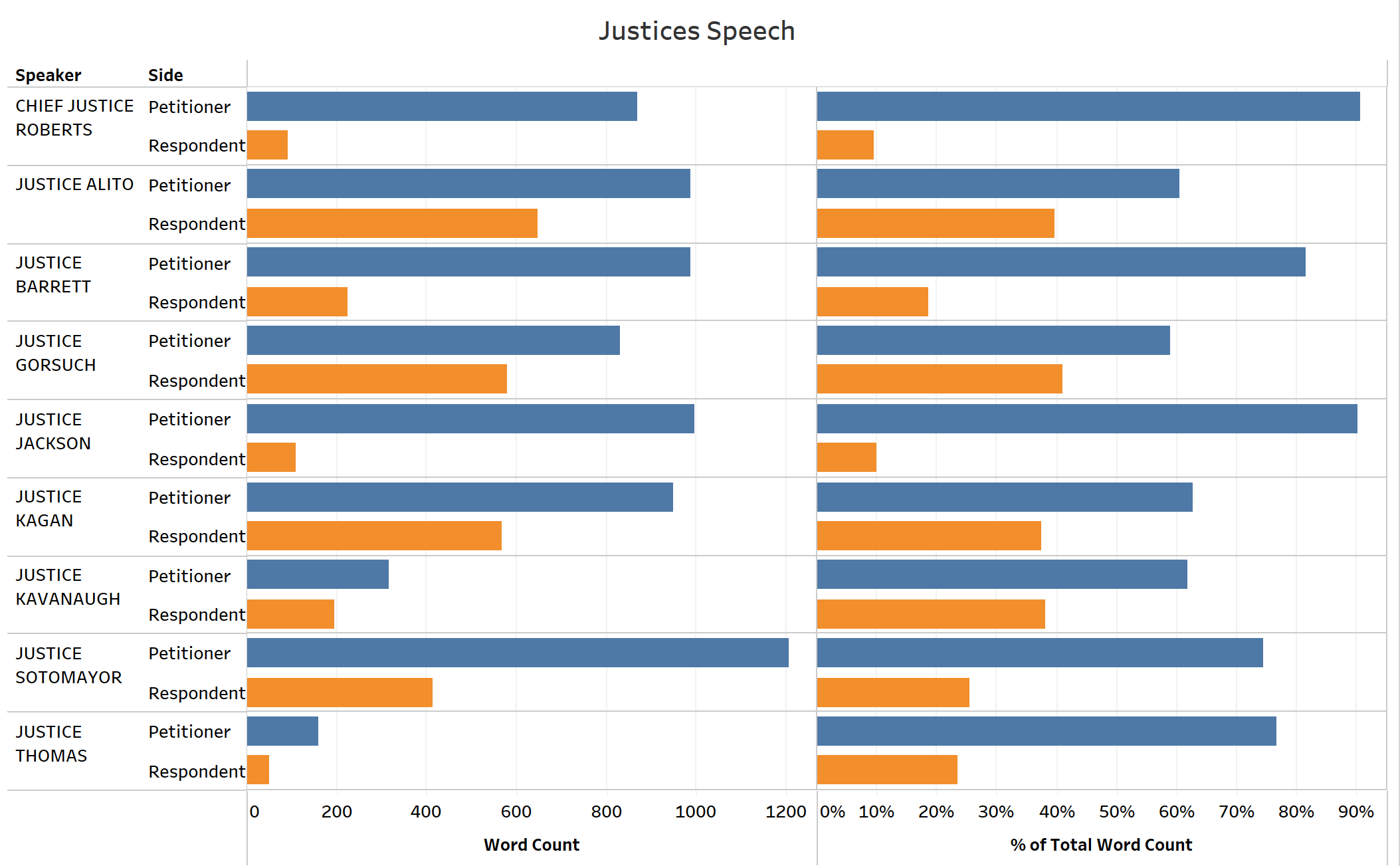
The numbers show the justices seem posed to uphold the TikTok ban based on their speech as they spoke much more to petitioners which should show favor for the government’s position. The justices that appear most in favor of the ban are Roberts, Jackson, and Barrett.
Ultimately the justices will need to act swiftly to provide a response before the law goes into effect. As Trump’s brief highlighted the possibility of postponing the ban in hopes of a political solution, that option is up in the air as well. We should have some resolution within the next nine days and with empirical data somewhat conflicting with the justices’ words, we will probably hear more conflicting reports of the likely outcome in the next few days. As I run more empirical tests on these arguments I’ll provide any additional thoughts and findings.
– Thanks to Jake Truscott for his SCOTUSText R Package which I implemented in running the quantitative analysis
Also on Legalytics Substack
 Empirical SCOTUS