The U.S. Supreme Court is set to hear a groundbreaking case that could pave the way for the nation’s first religious charter school. At the heart of the dispute is St. Isidore, a Catholic online school in Oklahoma, challenging a state ruling that blocked its bid to operate as a charter school, raising critical questions about the intersection of religious freedom and public education funding.
The combined cases of Oklahoma Statewide Charter School Board v. Drummond and St. Isidore of Seville Catholic Virtual School v. Drummond concern the issue of whether Oklahoma can exclude religiously affiliated charter schools from its charter-school program based on state laws that prevent the inclusion of “sectarian” schools. The central constitutional question revolves around whether such exclusion violates the Free Exercise Clause of the First Amendment, particularly in light of the Supreme Court’s past rulings, such as Trinity Lutheran Church v. Comer (2017), Espinoza v. Montana Department of Revenue (2020), and Carson v. Makin (2022). These cases have repeatedly struck down state actions that exclude religious schools or organizations from receiving otherwise available public benefits solely because they are religious.
In this instance, the Oklahoma Supreme Court ruled that a state could exclude religious charter schools from the charter-school program by considering them “public” schools under state law and classifying their religious education as state action. The Court’s decision exacerbates a split among lower courts on whether privately owned charter schools, which are funded by the state but operated independently, are engaged in “state action” for constitutional purposes.
The petitioners argue that this ruling conflicts with Supreme Court precedents, and they sought Supreme Court review to resolve the confusion over whether charter schools that contract with the state are engaged in state action. They also challenge the exclusion of religious schools from the charter-school program, asserting that such exclusion violates the Free Exercise Clause.
The two key legal questions presented to the Court are:
- Whether a privately owned and operated charter school, contracting with the state to provide education, can be considered engaged in state action.
- Whether excluding religious schools from a state’s charter-school program solely because they are religious violates the Free Exercise Clause of the Constitution, or if the state can justify such exclusion by invoking anti-establishment concerns that exceed what is required by the Establishment Clause.
The petitioners argued that the Court should intervene to clarify these constitutional issues, resolve the split in the lower courts, and ensure that religious schools are not penalized for their religious nature in the context of public educational programs.
Three of the main arguments made in the petition can be broken down as follows:
- Violation of the Free Exercise Clause:Oklahoma’s exclusion of St. Isidore from the charter school program solely because of its religious character violates the Free Exercise Clause, as established in Trinity Lutheran, Espinoza, and Carson. These precedents prohibit states from denying generally available public benefits to religious entities based on their religious status.
- Misapplication of the State-Action Doctrine:The Oklahoma Supreme Court erroneously classified St. Isidore as a state actor simply because it is labeled a “public” charter school and receives public funding. This conflicts with Supreme Court precedent, such as Rendell-Baker v. Kohn, which holds that extensive state regulation and funding do not transform private entities into state actors.
- Erroneous Establishment Clause Concerns:The lower court’s reliance on the Establishment Clause to justify excluding St. Isidore is flawed because it hinges on the incorrect premise that the school is a state actor. The Supreme Court has consistently held that neutral government programs benefiting religious organizations do not violate the Establishment Clause.
Elaboration of three essential cases cited in the cert petition
- Rendell-Baker v. Kohn (1982)This case is crucial because it established that significant state funding and regulation do not automatically transform a private entity into a state actor. The petition relies on Rendell-Baker to argue that Oklahoma’s charter schools, like the school in that case, retain autonomy in key decision-making, meaning their actions cannot be attributed to the state.
- Manhattan Community Access Corp. v. Halleck (2019)This case reinforces the principle that merely performing a function that serves the public does not make an entity a state actor unless the function is an inherently exclusive government function. The petition cites this case to refute the Oklahoma Supreme Court’s argument that St. Isidore is a state actor simply because it provides publicly funded education.
- Jackson v. Metropolitan Edison Co. (1974)This case holds that a private entity does not become a state actor just because it is labeled as “public” by state law. The petition invokes Jackson to argue that Oklahoma’s statutory classification of charter schools as “public” does not determine their constitutional status, countering the Oklahoma Supreme Court’s reliance on statutory labels.
A Conservative Revolution?
Conservative justices have maintained a majority in the Supreme Court for decades. The majority grew by one in 2020 after Justice Ginsburg passed and Justice Barrett took her seat. While Barrett has shown inklings that she may be more moderate than initially expected, she has been a consistent vote in favor of religious causes in the Supreme Court. This has propelled outcomes in favor of religious causes for the past several terms. Using the Supreme Court Database, the following graphs track the last 20 cases before the Supreme Court that were predicated on religious causes (the 20th case, Groff v. DeJoy was categorized as a civil rights rather than religious case but it clearly belongs in the set of religious cases). The first graph shows the number of cases per term.
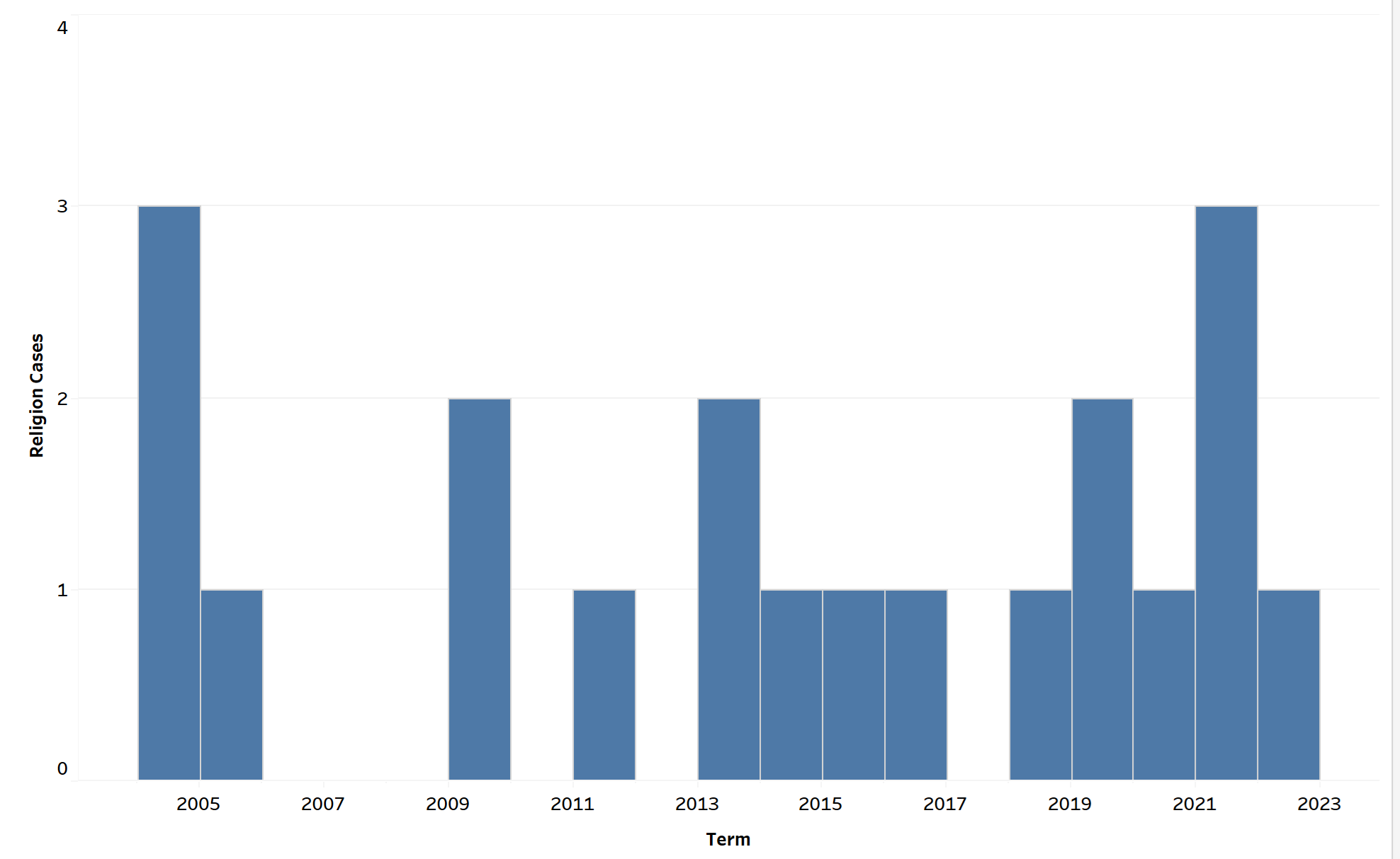
The 2021 Supreme Court Term saw the most cases focused on religion since 2004. That said, the Court did not take a case where the main issue revolved around the First Amendment’s religion clauses last term. The next graphs track the justices’ decisions starting with the majority authors of these opinions.
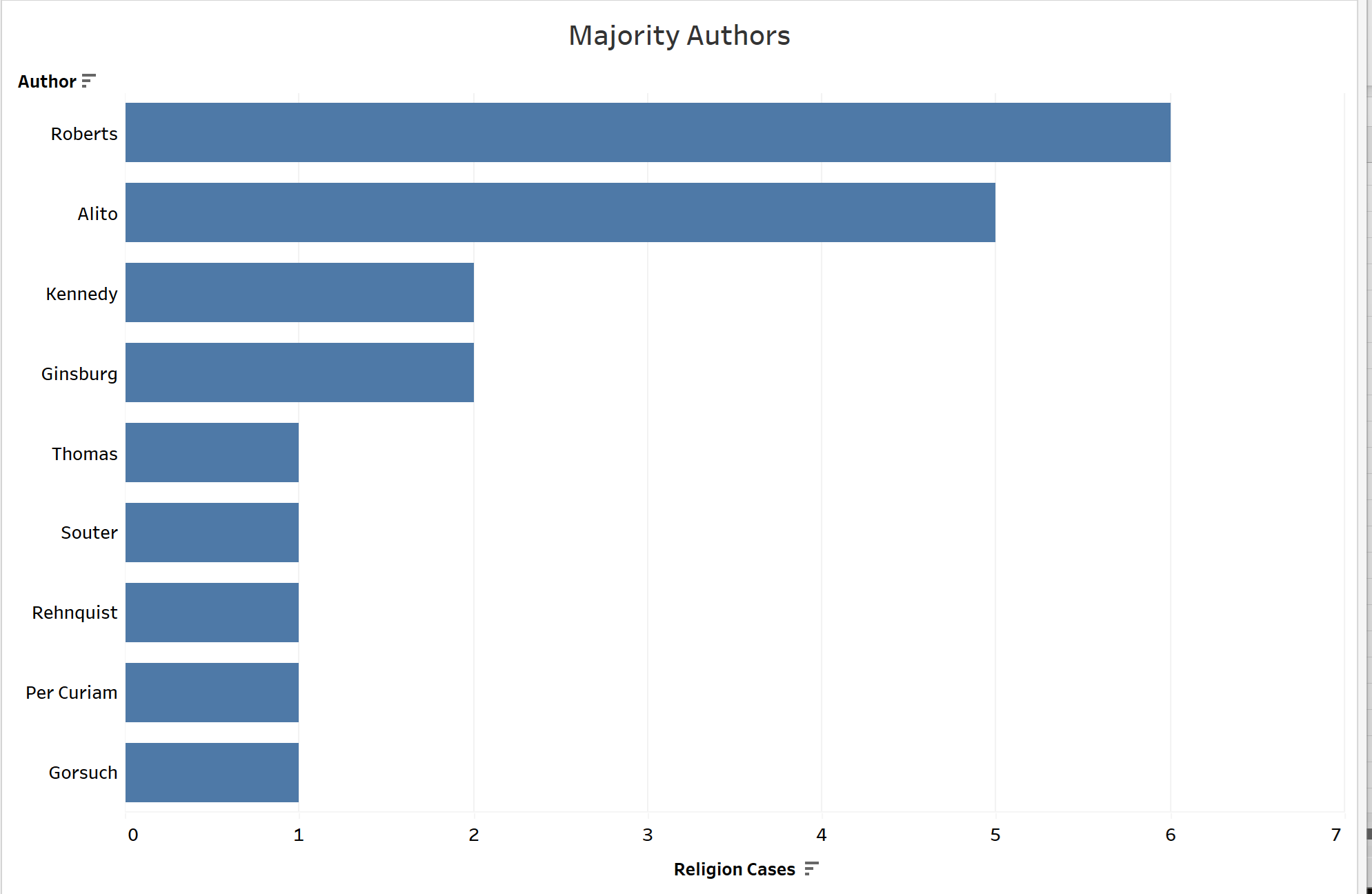
Chief Justice Roberts and Justice Alito decided several more cases than any of the other justices. Justice Ginsburg is the only clearly liberal justice to author more than one majority opinion in this area during this timeframe.
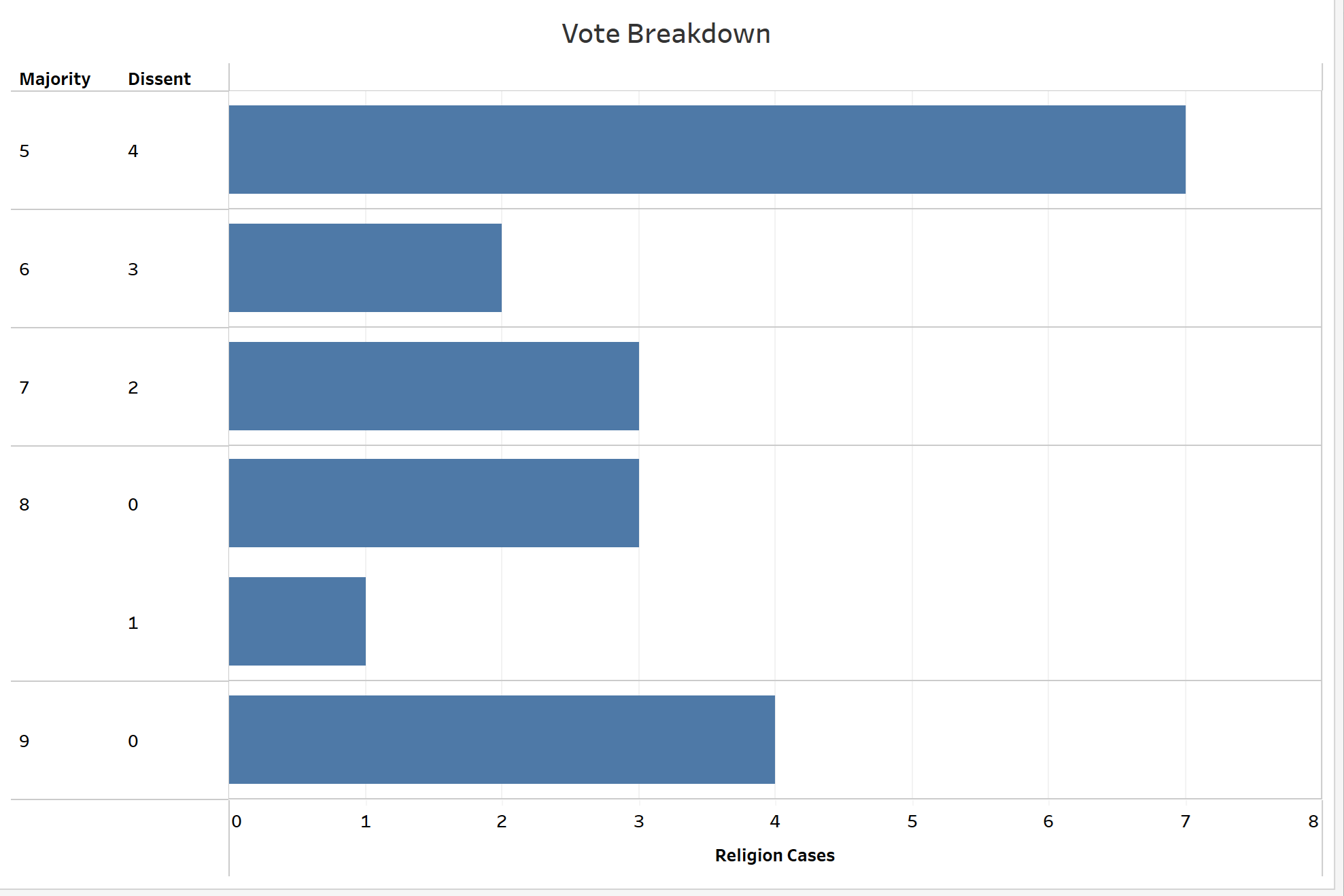
The vote breakdown shows the importance of the conservative majority. Both 6-3 decisions and most of the 5-4 decisions were across ideological lines. A handful of decisions including Groff were unanimous. In the closest cases though, the conservative majority has the votes to move outcomes in its favor if it so wishes.
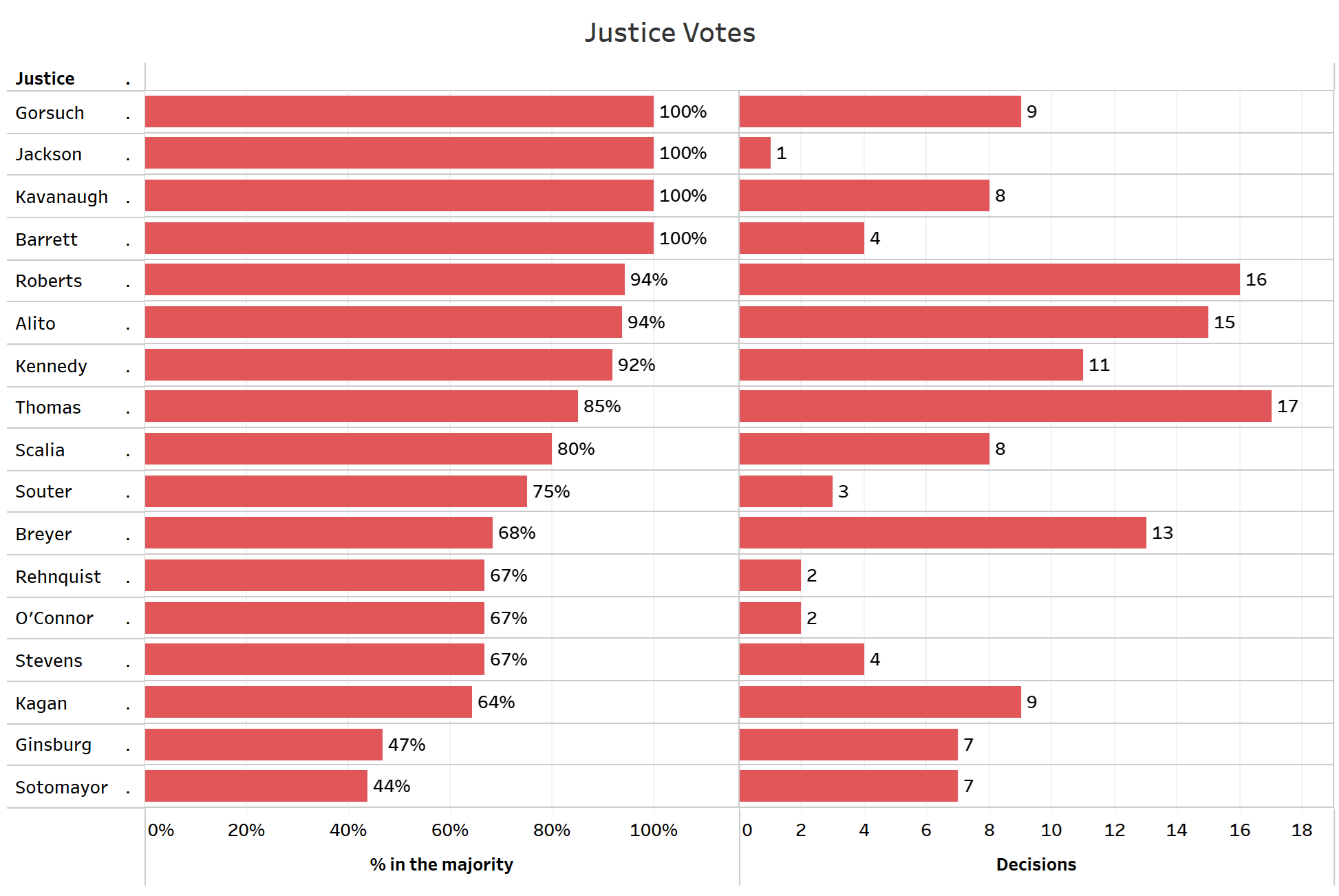
The breakdown of the justices’ votes help confirm the power in numbers. While Jackson’s one vote in a religious case, in Groff, was in the majority, the other eight justices with 80% or more in the majority in these cases were all conservatively minded and all decided many more cases than Jackson including Thomas with 17, Roberts with 16, and Alito with 15. The more liberal justices aside from Jackson were all in the bottom half of the justices in terms of frequencies in the majority.
More about Interests in Oklahoma Statewide Charter School Board v. Drummond
Drummond’s Argument below:
- Protection of Religious Liberty Through Separation of Church and StateThe Oklahoma Attorney General argued that the sponsorship of St. Isidore of Seville Virtual Charter School violates the Oklahoma Constitution, which explicitly prohibits the use of public funds for sectarian institutions. This separation ensures that no religion is favored or disadvantaged, protecting religious liberty by maintaining a neutral public space where all faiths can coexist without state interference.
- Danger of State-Sponsored ReligionAllowing state funding for a Catholic charter school sets a precedent for funding other religious schools, potentially leading to conflicts over which religions receive public support. This undermines religious liberty by risking state endorsement of certain religions, creating societal divisions, and eroding the principle of religious neutrality enshrined in the Oklahoma Constitution.
- The Broader Implications for First Amendment and State ActionThe case highlights the tension between religious liberty and state action, particularly when a religious institution becomes a state actor through public funding and oversight. By turning St. Isidore into a state-sponsored entity, the government risks violating the Establishment Clause, which prohibits state endorsement of religion, thereby threatening the foundational principle of religious liberty for all citizens.
Points from Brief in Opposition Brief in St. Isidore
- The Establishment Clause Prohibits Government Creation of Religious InstitutionsThe brief argues that the Oklahoma government’s approval of St. Isidore of Seville Virtual Charter School violates the Establishment Clause of the First Amendment. While states can establish public institutions, they cannot create religious ones. The case hinges on the distinction between allowing religious institutions access to public funds (which implicates the Free Exercise Clause) and the government itself establishing a religious institution, which the brief asserts is unconstitutional.
- St. Isidore is a Public, State-Sponsored Religious SchoolUnder Oklahoma law, all charter schools are considered public schools. St. Isidore, although religious in nature, was created through a charter granted by the state. The brief highlights that public charter schools operate as government-sponsored entities, making the state’s role in establishing a religious school constitutionally impermissible. Prior Supreme Court precedent has consistently ruled against direct government sponsorship of religious institutions.
- The Charter for St. Isidore Violates the First AmendmentBy approving St. Isidore as a religious charter school, the Oklahoma Statewide Virtual Charter School Board has effectively created a state-sponsored religious entity, crossing the constitutional boundary established by the First Amendment. The brief emphasizes that this action is distinct from cases involving religious schools receiving neutral government aid—it is direct government endorsement and sponsorship of religion. As such, the brief urges that the state’s action be deemed unconstitutional.
Amicus Briefs
Manhattan Institute Amicus Brief in Support of Cert
- State-Action Designation Threatens Religious OrganizationsLabeling religious organizations as state actors forces them to choose between maintaining their religious identity or ceasing public service. This threatens their ability to operate in accordance with their faith and could lead to the loss of essential social services.
- Religious Organizations Provide Critical Public ServicesFaith-based groups play a crucial role in adoption services, childcare, emergency shelters, food pantries, healthcare, and refugee assistance. If government policies force them out, many vulnerable populations will lose access to these vital resources.
- State Discrimination Violates Free Exercise ProtectionsRecent Supreme Court decisions affirm that governments cannot exclude religious organizations from public benefit programs based on their faith. The Oklahoma ruling undermines this principle by imposing burdens on religious entities that secular groups do not face.
Wisconsin Institute for Law and Liberty Amicus Brief in Support of Cert
- Sectarian Control Prohibitions in State ConstitutionsThe Oklahoma Constitution, like many others, includes provisions to ensure public schools are “free from sectarian control.” However, these provisions, while aiming to protect religious freedom, were historically influenced by anti-Catholic sentiment, which raises concerns about their compatibility with the First Amendment’s anti-discrimination principles.
- Tainted History of Blaine AmendmentsBlaine Amendments, which are present in the constitutions of 37 states, were originally motivated by anti-Catholic animus. Courts, such as in New Mexico and Montana, have expressed skepticism about enforcing these provisions due to their discriminatory origins, recognizing their conflict with modern religious liberty protections.
- Religious Entities and Public BenefitsThe Supreme Court’s decision in Espinoza v. Montana Department of Revenue established that once a state offers public benefits, it cannot exclude religious entities based solely on their religious character. This principle should apply to state Blaine Amendments, ensuring that public benefits are not withheld from religious institutions, reinforcing religious freedom under the First Amendment.
Brief of Buckeye Institute in support of cert
- Charter Schools Should Include Religious Instruction to Uphold Parental Choice and Freedom
Allowing charter schools to include religious instruction respects the rights of parents to choose an education that aligns with their values and beliefs. This is especially important for families in underserved communities who may seek faith-based education as an alternative to underperforming public schools. - Including Religious Instruction in Charter Schools Aligns with Legal Precedent and Bipartisan Support
The U.S. Supreme Court’s decision in Zelman v. Simmons-Harris (2002) upheld the constitutionality of using public funds for private religious schools, demonstrating that religious instruction in publicly supported programs does not violate the Establishment Clause. Bipartisan support for school choice further underscores the legitimacy of including religious options in charter schools. - Excluding Religious Instruction Limits Educational Diversity and Innovation
Preventing charter schools from offering religious instruction restricts the diversity of educational options available to families. Charter schools are designed to provide innovative and tailored education, and excluding religious instruction undermines their ability to meet the varied needs and preferences of students and parents.
Brief for Classical Charter Schools of America et al. in support of cert
- The Court Should Take the Case to Resolve a Critical Circuit Split on Charter Schools as State Actors
The Fourth Circuit’s decision in Peltier v. Charter Day School and the Oklahoma Supreme Court’s ruling create a circuit split, with other circuits holding that charter schools are not state actors. This inconsistency demands Supreme Court intervention to provide clarity and uniformity on whether charter schools can be sued under Section 1983. - Labeling Charter Schools as State Actors Undermines Their Purpose and Innovation
Charter schools were designed to offer innovative, diverse educational options free from the constraints of traditional public schools. Treating them as state actors would subject them to endless litigation, stifling their ability to innovate and deterring individuals from starting or serving on charter school boards. - The Court Should Rule That Charter Schools Are Not State Actors to Protect Parental Choice and Educational Diversity
The Court should affirm that charter schools, despite public funding, are not state actors because they operate independently and are chosen voluntarily by parents. This ruling would preserve their unique educational models, protect parental choice, and prevent the erosion of educational diversity through excessive litigation.
Brief of Oklahoma Governor J. Kevin Stitt as Amicus Curiae in Support of Petitioners
- Charter Schools Should Be Allowed to Incorporate Religious Instruction to Enhance Educational Diversity and Parental Choice
Religious charter schools, like St. Isidore, provide unique educational benefits, including academic rigor, moral development, and cultural preservation, which align with the State’s interest in offering diverse educational options. Excluding religious entities from charter school programs undermines parental choice and deprives students of valuable educational opportunities that combine the flexibility of private schools with the accessibility of public funding. - Excluding Religious Charter Schools Violates the Free Exercise Clause and Fails Strict Scrutiny
The Oklahoma Supreme Court’s decision to exclude St. Isidore from the charter school program solely based on its religious status violates the Free Exercise Clause. This exclusion cannot withstand strict scrutiny, as the State has no compelling interest in denying religious schools access to generally available public benefits, especially when such discrimination is rooted in outdated and discriminatory state constitutional provisions. - The Court Should Rule That Religious Charter Schools Do Not Violate the Establishment Clause
The Court should affirm that allowing religious charter schools does not constitute an establishment of religion, as there is no government coercion or endorsement of religion. Parents and students voluntarily choose to attend these schools, and the State’s oversight does not equate to control over religious practices. This ruling would align with precedent and ensure that religious schools are treated equally under the law.
Amicus Brief of Center for Constitutional Jurisprudence in support of petition
- Oklahoma’s Argument on Private Religious Entities as State ActorsOklahoma argues that when a private entity sponsors a charter school, it becomes a state actor, thereby invoking the Establishment Clause to defend against discrimination of religious entities. This interpretation ignores the history of the Establishment Clause, which was not intended to allow states to discriminate against religion in the administration of state benefits.
- Establishment Clause as a Federalism ProtectionThe Establishment Clause was originally understood as a protection for states against federal interference in religious matters, not as a prohibition against religious participation in state programs. The Clause was meant to ensure that the federal government could not impose a national religion on the states, respecting state authority to support religion as they see fit.
- Establishment Clause Protection Against Coercion, Not Religious ParticipationThe Establishment Clause should only protect individuals and religious institutions from government coercion in religious matters. It does not mandate the exclusion of religious entities from generally available state programs, such as charter school sponsorship, which do not involve coercion or the establishment of a national religion.
Brief amici curiae of the Jewish Coalition for Religious Liberty, et al. filed
- The Attorney General’s Actions Are Tainted by Religious Discrimination in Violation of the First Amendment
The Oklahoma Attorney General’s explicit hostility toward religious minorities, particularly his disparaging remarks about Islam and other faiths, demonstrates animus that violates the First Amendment’s mandate of religious neutrality. His actions to block St. Isidore’s charter school are motivated by discriminatory intent, as evidenced by his repeated references to “radical Muslim teachings” and “Sharia law” as reasons to deny public funding to religious schools. - Educational Choice, Including Religious Options, Benefits Families and Upholds American Values
Expanding educational choice to include religious charter schools provides significant benefits to families, particularly those from minority faiths who seek schools aligned with their values. Religious schools often offer unique educational environments that foster academic excellence, moral development, and cultural preservation, which are consistent with the principles of diversity and pluralism. - The Oklahoma Supreme Court Erred in Ignoring the Attorney General’s Religious Animus
The Oklahoma Supreme Court failed to address the Attorney General’s explicit religious discrimination, disregarding decades of Supreme Court precedent that prohibits government actions motivated by animus toward religion. This oversight necessitates Supreme Court intervention to ensure that state actions are not tainted by religious bias and to uphold the constitutional rights of religious minorities.
- Charter Schools and State Influence
Charter schools, if considered state actors, may be pressured to adopt public school methods and avoid innovative educational approaches to prevent legal challenges or loss of state funding. - Free Exercise Clause vs. Religious Discrimination
The Court’s recent precedents, including Trinity Lutheran, Espinoza, and Carson, emphasize that states cannot deny funding or benefits to religious entities based solely on their religious identity or character, protecting free exercise rights under the Constitution. - Establishment Clause Misapplication
The Oklahoma Supreme Court misapplied the Establishment Clause, which historically allows government support for religious schools, and failed to consider the long-standing practice of state and federal funding for religious institutions.
Brief amicus curiae of National Alliance for Public Charter Schools (Note: It is unusual to have cert stage amicus briefs arguing against cert. This article helps to explain why)
- Religious Nature of St. Isidore:St. Isidore is fundamentally rooted in Catholic doctrine, which is reflected not only in its mission statement but in the structure of its curriculum, with mandatory religious classes and practices such as daily prayers, chapel services, and faith-based extracurricular activities. This consistent religious environment, deeply intertwined with its educational model, highlights the religious nature of the school and reinforces its primary identity as a religious institution.
- Violation of the Establishment Clause:The state’s funding of a religiously affiliated institution like St. Isidore, which mandates religious instruction as part of its curriculum, constitutes a clear violation of the Establishment Clause. This is because the state’s endorsement of religious education infringes upon the constitutional principle that government must remain neutral on matters of religion, preventing public funds from supporting religious activities or institutions, as established in landmark cases like Lemon v. Kurtzman and Everson v. Board of Education.
- Attribution of State Action:By providing financial support, establishing curriculum guidelines, and exercising oversight over operational aspects of St. Isidore, the state effectively becomes a participant in promoting religious instruction. This entanglement between government and religion raises concerns about state action, as it implies government endorsement and facilitation of religious practices, which courts have historically ruled as unconstitutional when government becomes too involved in religious matters, as outlined in Agostini v. Felton.
Third Party Commentary
- Americans United for Separation of Church and State, the American Civil Liberties Union, Education Law Center, and Freedom From Religion Foundation Statement: “The law is clear: Charter schools are public schools and must be secular and open to all students. The Oklahoma Supreme Court correctly found that the state’s approval of a religious public charter school was unlawful and unconstitutional. We urge the U.S. Supreme Court to affirm that ruling and safeguard public education, church-state separation, and religious freedom for all. Oklahoma taxpayers, including our plaintiffs, should not be forced to fund a religious public school that plans to discriminate against students and staff and indoctrinate students into one religion. Converting public schools into Sunday schools would be a dangerous sea change for our democracy.”
- Mark Walsh wrote for Education Week about how funding a religious charter school with public money violates the Establishment Clause by making the state responsible for advancing religious doctrine. The court rejects claims that denying such funding constitutes religious discrimination, emphasizing that the state cannot create or financially support religious institutions without breaching constitutional boundaries.
- Ian Millhiser from Vox: “Worse, what happens if the Lutheran school only admits students who share the school’s religious faith? Will the Supreme Court enforce the ban on religious discrimination? Or will it effectively rule that Hindu children in this neighborhood must attend a separate and unequal public school?”
- Alliance Defending Freedom included in its press release: “Oklahoma parents and children are better off with more educational choices, not fewer. There’s great irony in state officials who claim to be in favor of religious liberty discriminating against St. Isidore because of its Catholic beliefs,” said ADF Chief Legal Counsel Jim Campbell. “The U.S. Constitution protects St. Isidore’s freedom to operate according to its faith and supports the board’s decision to approve such learning options for Oklahoma families. We’re pleased the U.S. Supreme Court will hear this case, which is of the utmost import to families and children in Oklahoma and throughout the country.”
Takeaway
In the end, these legal questions go beyond technical arguments—they shape how laws are understood and applied in everyday life. This article explored the key points, examined the reasoning behind different perspectives, and considered the broader implications. While interpretations may differ, what remains clear is the lasting impact of these decisions. As legal discussions continue to evolve, understanding these nuances helps us engage with the law in a more informed and thoughtful way.
Also available on Legalytics.
 Empirical SCOTUS