A tariff case that complicates the usual shorthand
The Supreme Court’s tariff decision in Learning Resources v. Trump offers a useful opening window into the Court’s oral-argument term. The case had all the markers of a major separation-of-powers dispute: presidential emergency authority, economic policy, foreign affairs, Congress’s tariff power, and the Trump administration’s claim that IEEPA gave the president sweeping authority over import duties.
The oral argument reflected that intensity in more concrete ways than a single composite score can show. The justices spoke 12,181 words in Learning Resources, the second-highest justice-word total in the dataset. Counsel spoke 16,236 words, making it the longest argument in the term by total transcript volume. The justice-to-advocate word ratio was 0.75 (the justices spoke about 75 words for every 100 words from the advocates). By those measures — justice words, total words, and the balance between the bench and counsel — Learning Resources was one of the most active arguments of OT2025.
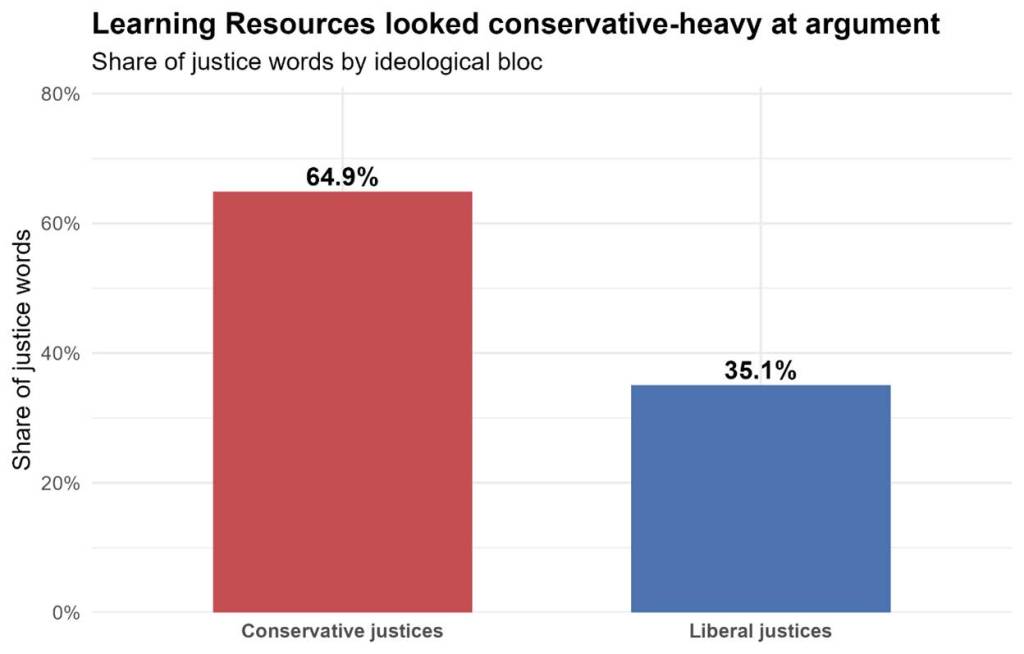
It also looked conservative-heavy at argument. Conservative justices accounted for 64.9% of the justice words. Liberal justices accounted for 35.1%. On the transcript alone, the case seemed to draw especially heavy participation from the Court’s conservative side.
The decision that followed was more revealing. The Court rejected the administration’s tariff theory, holding that IEEPA does not authorize the president to impose tariffs. The vote was 6-3, but the alignment did not follow the Court’s familiar conservative-liberal split. Roberts, Gorsuch, and Barrett joined Sotomayor, Kagan, and Jackson in the core majority. Thomas, Alito, and Kavanaugh dissented.
That makes Learning Resources a useful example for the broader question in this article: what does oral argument show about the Court’s composition? The Court is formally a 6-3 conservative Court. Its decisions often invite that description. Yet the oral-argument transcript tells a more fluid story. Some cases are conservative-heavy. Some are liberal-heavy. Many are balanced. And even a conservative-heavy argument can produce a cross-bloc outcome.
The point is not that oral argument predicted the result in Learning Resources. It did not, at least not in any simple bloc-based way. The point is that oral argument gives a separate view of the Court. It shows which justices chose to occupy the public conversation in a case before the votes and opinions gave the dispute its final legal form.
Across the term, the transcript was close to even
The term wide numbers show why Learning Resources is not just an isolated curiosity. Across 58 OT2025 arguments, the six conservative justices supplied only a narrow majority of justice words. The conservative bloc spoke 173,735 words. The liberal bloc spoke 167,839. Put differently, conservative justices accounted for 50.9% of justice speech, while the three liberal justices accounted for 49.1%.
That is a strikingly close division for a Court with twice as many conservative justices as liberal justices. The difference between the two blocs was 5,896 words across the entire argued docket. In transcript terms, the Court’s six-member conservative majority held only a slim volume advantage.
The per-justice numbers sharpen the picture. The liberal justices averaged 55,946 words each. The conservative justices averaged 28,956. On a per-seat basis, the liberal justices spoke at about 1.93 times the rate of the conservative justices.
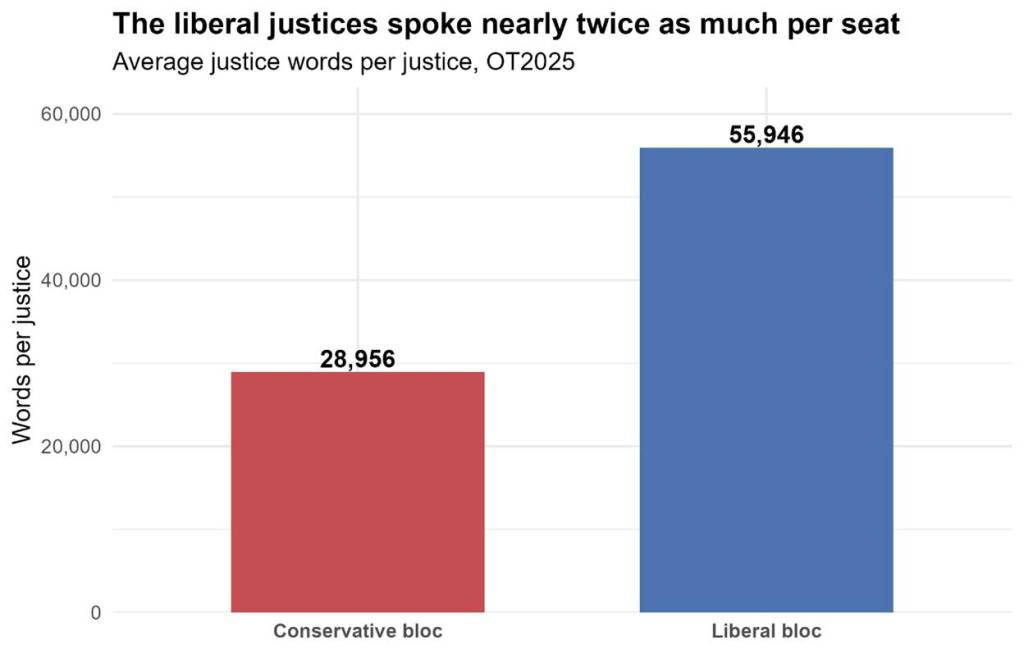
This does not make the oral-argument term a mirror image of the Court’s ideological composition. Conservative justices still spoke slightly more in the aggregate, and they led in slightly more individual cases. But the transcript does not resemble the seat count. A 6-3 Court produced a justice-side transcript that was much closer to 51-49.
The case-level picture is more balanced than the seat count suggests
The term wide split is the starting point, but the case-level data are more revealing. Across all arguments, the conservative bloc had a small word-volume edge. Inside individual arguments, however, the pattern was less uniform.
To get at that, each case was classified by the bloc share of justice words. Arguments were coded as “balanced” when each bloc fell between 45 and 55% of justice words. A case was “conservative-heavy” or “liberal-heavy” when one bloc exceeded 60%. Cases in between were coded as mildly conservative or mildly liberal.
The largest category was balanced arguments. Twenty-six of the 58 arguments fell into that middle range. Eleven were liberal-heavy. Eight were conservative-heavy. Another seven were mildly liberal, while six were mildly conservative.
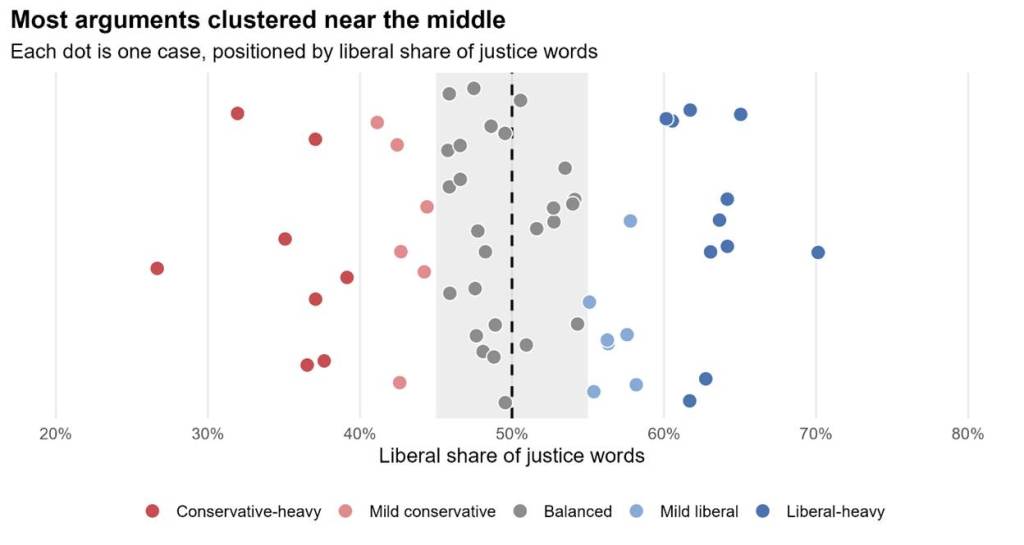
That distribution is important because it keeps the aggregate numbers from doing too much work. The near-even term wide split was not just the product of a few unusually talkative liberal arguments offsetting a conservative baseline. Nearly half the docket was balanced at the level of individual cases. The remaining cases tilted in both directions, with liberal-heavy arguments appearing slightly more often than conservative-heavy ones.
The leading-bloc count tells a similar story from another angle. Conservative justices supplied more words in 31 arguments. Liberal justices supplied more in 27. That is a conservative edge, but a narrow one. The difference between the two groups was four cases across the term.
Taken together, the case-level data make the Court’s oral-argument structure look fluid. Conservative participation was real, and conservatives led slightly more arguments. Liberal participation was also unusually strong, both in total volume and in the number of strongly liberal-heavy arguments. The seat count alone does not capture that balance.
A three-group lens brings the participation pattern into sharper focus
The standard bloc comparison treats the Court as six conservatives and three liberals. That is the conventional shorthand, and it is useful as a first cut. But the oral-argument transcript also supports another view: three liberals, three center-right conservatives, and three more right-leaning conservatives.
For this purpose, the groups are: Sotomayor, Kagan, and Jackson; Roberts, Kavanaugh, and Barrett; and Thomas, Alito, and Gorsuch. This grouping is a participation lens. It is not a claim about voting coalitions, case outcomes, or agreement on the merits.
The results are striking. The three liberal justices supplied 167,839 words, or 49.1% of all justice words. Roberts, Kavanaugh, and Barrett supplied 91,315 words, or 26.7%. Thomas, Alito, and Gorsuch supplied 82,420 words, or 24.1%.
This view helps explain why the 6–3 shorthand fits oral argument poorly. The liberal bloc operated as the largest participation cluster. The conservative justices divided the remaining half of the transcript across two smaller clusters.
The case-level version of the same comparison is even more dramatic. Under the three-group setup, the liberal bloc had the largest share of justice words in 53 of 58 arguments. Roberts, Kavanaugh, and Barrett led four arguments. Thomas, Alito, and Gorsuch led one.

This point is key for understanding current arguments. The decisional Court is often described through a 6–3 ideological frame. The oral-argument Court, at least in OT2025, had a different shape: one highly active liberal cluster, two smaller conservative clusters, and many individual arguments where neither ideological bloc dominated the transcript.
Jackson is the reason the liberal bloc changes the shape of the transcript
The liberal bloc’s near parity was not evenly distributed across the three liberal justices. All three were active, but Justice Jackson was the central figure in the transcript.
Jackson spoke 75,149 words, accounting for 22.0% of all justice words. She led the Court in total word count by a wide margin. Sotomayor was second, with 50,592 words. Kagan followed with 42,098. The highest-volume conservative justice was Gorsuch, with 39,532.
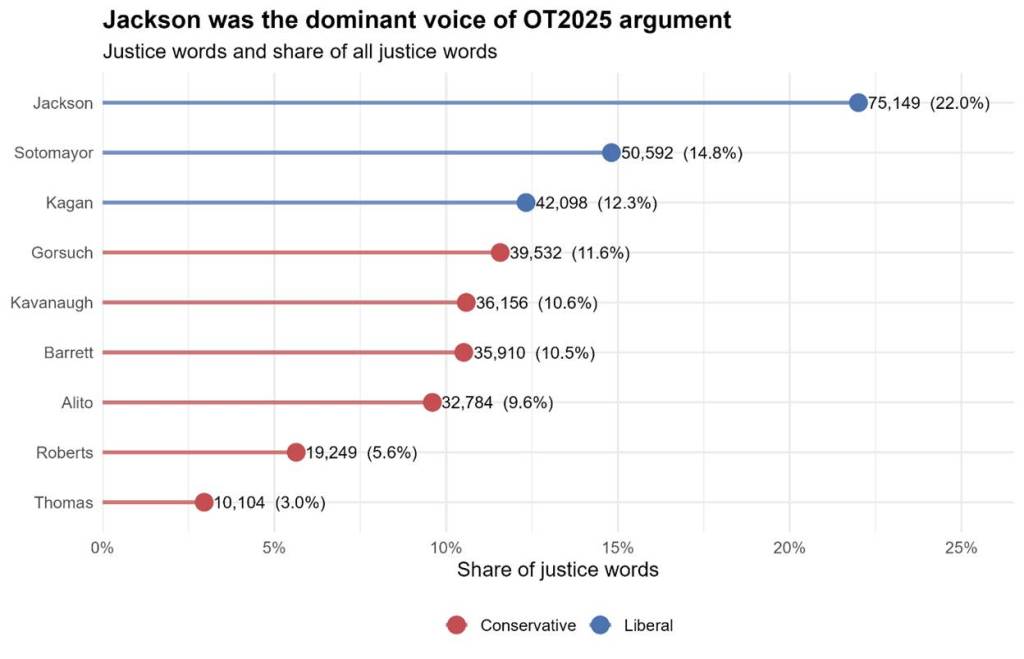
Jackson’s dominance also appears case by case. She led the justices in word count in 41 of the 58 arguments. She ranked among the top three speaking justices in 56 arguments. She was never in the bottom three. She exceeded 1,000 words in 36 arguments.
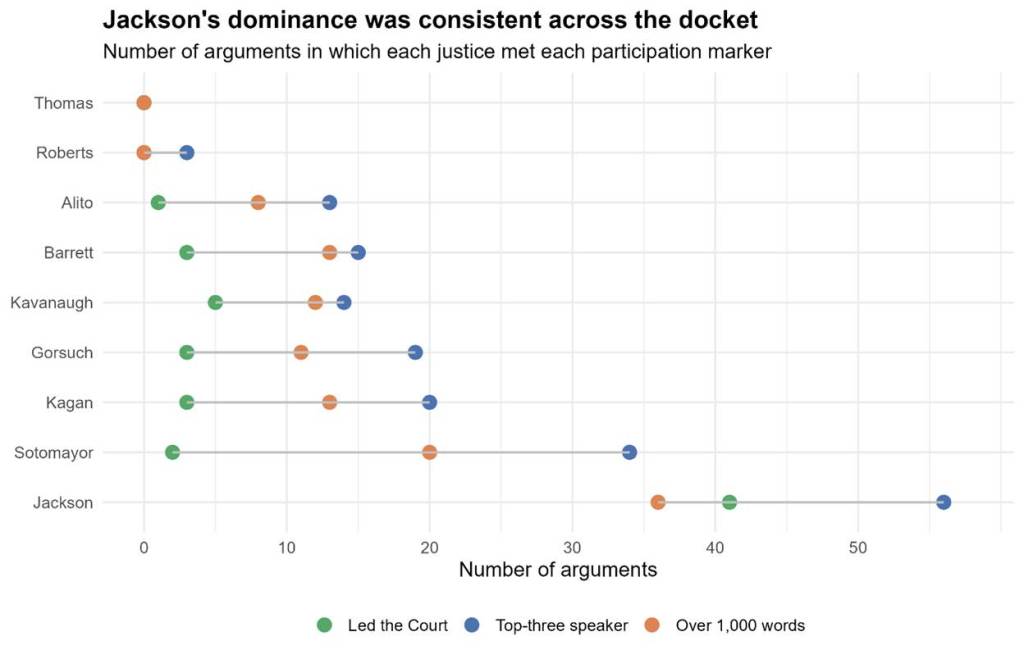
That consistency matters. The liberal bloc’s transcript strength was not just a function of one or two high-profile arguments. Jackson was a major presence across nearly the whole docket. She helped turn a six-conservative, three-liberal Court into something much closer to parity at oral argument.
This is also where the distinction between institutional power and public participation becomes clearest. Jackson did not change the Court’s membership. She changed the transcript. In a term when the Court’s formal balance remained 6-3, she made the liberal bloc far more visible in the public record of argument than the seat count would suggest.
Conservative participation was real, but uneven
The conservative bloc still supplied a narrow majority of justice words. But that majority did not come from six equally active justices.
Most conservative-bloc speech came from four justices: Gorsuch, Kavanaugh, Barrett, and Alito. Together, they supplied 144,382 words. Roberts and Thomas supplied 29,353 words combined. That means two members of the six-justice conservative majority accounted for only 16.9% of conservative-bloc words.
Roberts and Thomas reached that lower-volume position in different ways. Thomas simply spoke less often and less overall. Roberts had many turns, but many of them were short administrative interventions. His median turn was five words, and 71.6% of his turns were under 10 words.
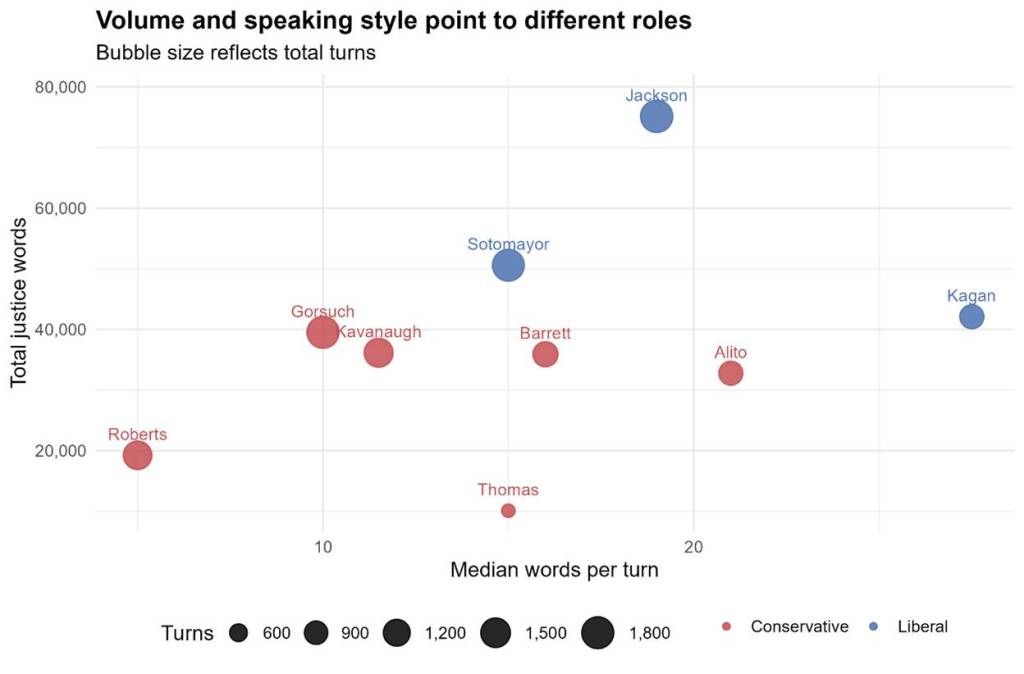
Roberts’s boilerplate is not interesting by itself. Calling on colleagues and thanking counsel are part of the Chief Justice’s job. The reason it matters here is structural. Roberts counts as one of the six conservative justices, but his oral-argument role contributes relatively little to conservative-bloc word volume. That helps explain why a six-justice conservative majority produced only a 50.9% share of justice words.
The conservative side of the transcript, then, was not a single block moving in unison. It was concentrated in a smaller set of frequent speakers, with Roberts and Thomas occupying lower-volume roles. Combined with Jackson’s unusually high participation, that unevenness is what makes the oral-argument Court look less like a simple 6-3 Court and more like a fluid participation structure.
Why the speaking pattern matters
Word counts across argument do not provide strong inferences about votes. A justice who speaks more on the aggregate is not necessarily more skeptical, more influential, or more likely to write the opinion. Oral argument is a public conversation, and the transcript captures only one part of the Court’s decision-making process.
But speaking patterns still matter. They show which justices occupied the argument, which blocs pressed the public discussion, and which cases drew concentrated attention from particular parts of the Court. When a case is balanced, the transcript suggests broad participation across ideological lines. When it is sharply tilted, the transcript shows that one bloc had a greater chance to probe issues of interest.
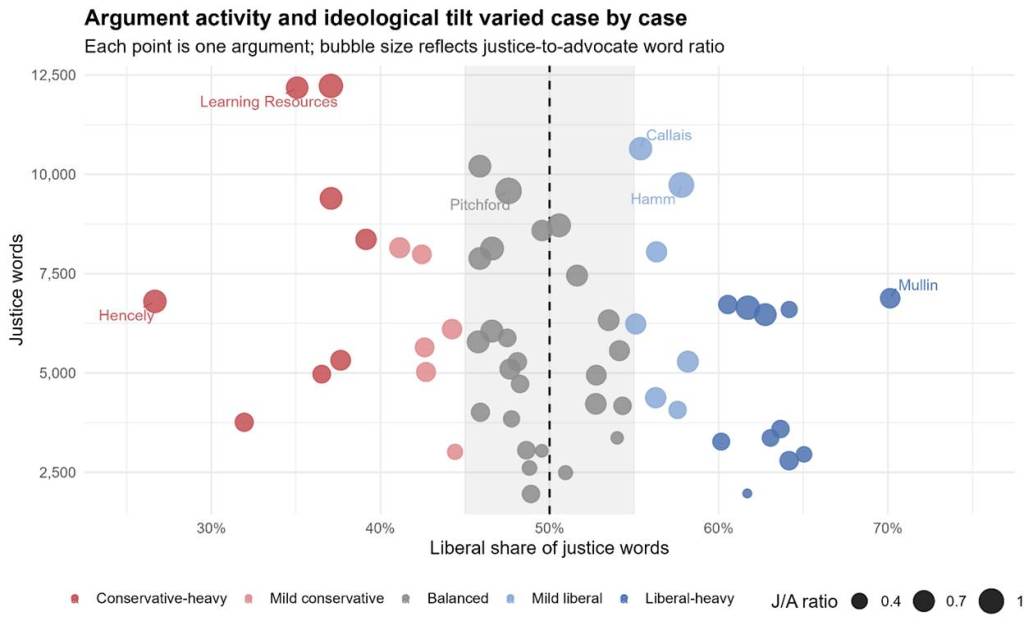
That case-level map separates two questions that are often collapsed. One question is how active the Court was in a case. Another is which bloc supplied most of that activity. Some high-volume arguments were conservative-heavy, including Learning Resources. Others were closer to balanced. Still others tilted liberal. The result is a more textured picture than a single term wide split can provide.
The core point is that oral argument does not merely echo the Court’s seat count. It shows case-specific engagement. In some disputes, the conservative justices took up more of the transcript. In others, the liberal justices did. In many, neither bloc dominated. That variation is part of the story of the term.
Outcomes add a useful caution
Outcomes can sharpen the analysis, but they also show why oral-argument participation should not be treated as a prediction tool. The best example remains Learning Resources. The argument was conservative-heavy by word share. The outcome was cross-bloc, with Roberts, Gorsuch, and Barrett joining the liberal justices in the core majority and Thomas, Alito, and Kavanaugh dissenting.
Louisiana v. Callais points in another direction. It was only mildly liberal-heavy at argument, but the decision produced the familiar 6-3 ideological alignment: the six conservative justices in the majority and the three liberal justices in dissent.
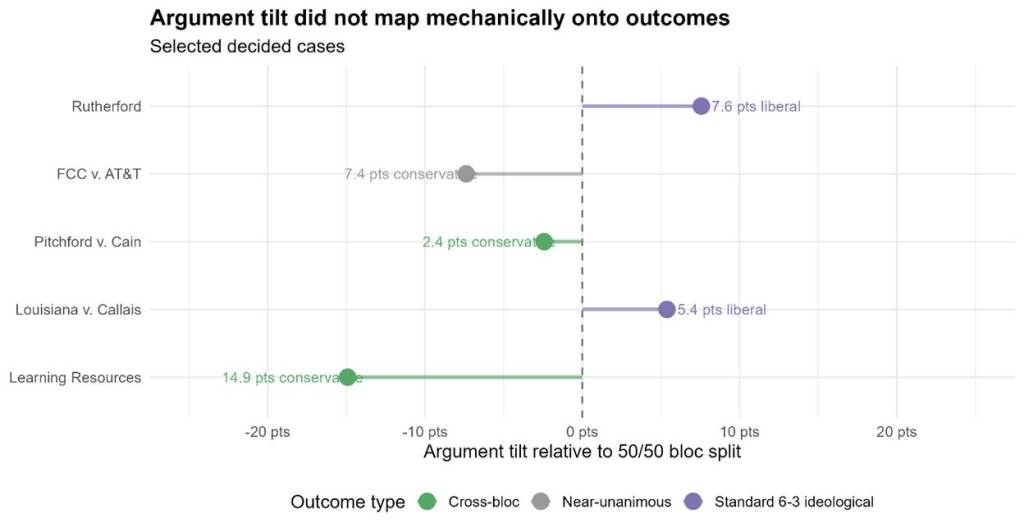
Those examples help frame what the transcript can and cannot do. Speaking more may identify which justices took public ownership of the argument. It may point to cases that activated particular blocs. It may help explain why some arguments sounded different from the Court’s eventual vote. But the relationship between argument and outcome is indirect.
That indirect relationship is exactly why the transcript is useful. It gives a second map of the Court — not the final merits map, and not a substitute for the opinions, but a public record of how the justices distributed attention before the vote became visible.

